Industrial robotics
Machines and manipulators built for the operation they serve, not adapted from a catalogue.
Robotics engineering · Santiago, Chile
Vessel Robotics designs, develops, and builds custom technology in robotics, automation, embedded systems, and artificial intelligence.
When what an operation needs can’t be bought ready-made, it has to be engineered. We work end to end, from concept to deployment, and we also advise when what’s needed is engineering judgment rather than a finished product.
Machines and manipulators built for the operation they serve, not adapted from a catalogue.
Firmware and hardware designed together, from board bring-up to field deployment.
Detection and measurement pipelines running on real production footage.
Electronics, enclosures and integration engineered for harsh environments.
Control logic and tooling that removes the manual step nobody wanted to own.
Engineering judgment when what you need is a decision, not a product.
On a mining site, tread wear is measured by hand today, with a ruler, intermittently and without traceability. Without reliable history there is no way to anticipate the right moment to change a tyre: too early wastes the life of an expensive asset, too late exposes the operation to a failure in the field.
We designed a passive sensing system embedded in the tyre structure. A sacrificial element wears down together with the tread and changes a measurable electrical property, read wirelessly by a reader on board the truck, with no battery and no active electronics in the module. The data reaches the backend and is shown on a web dashboard.
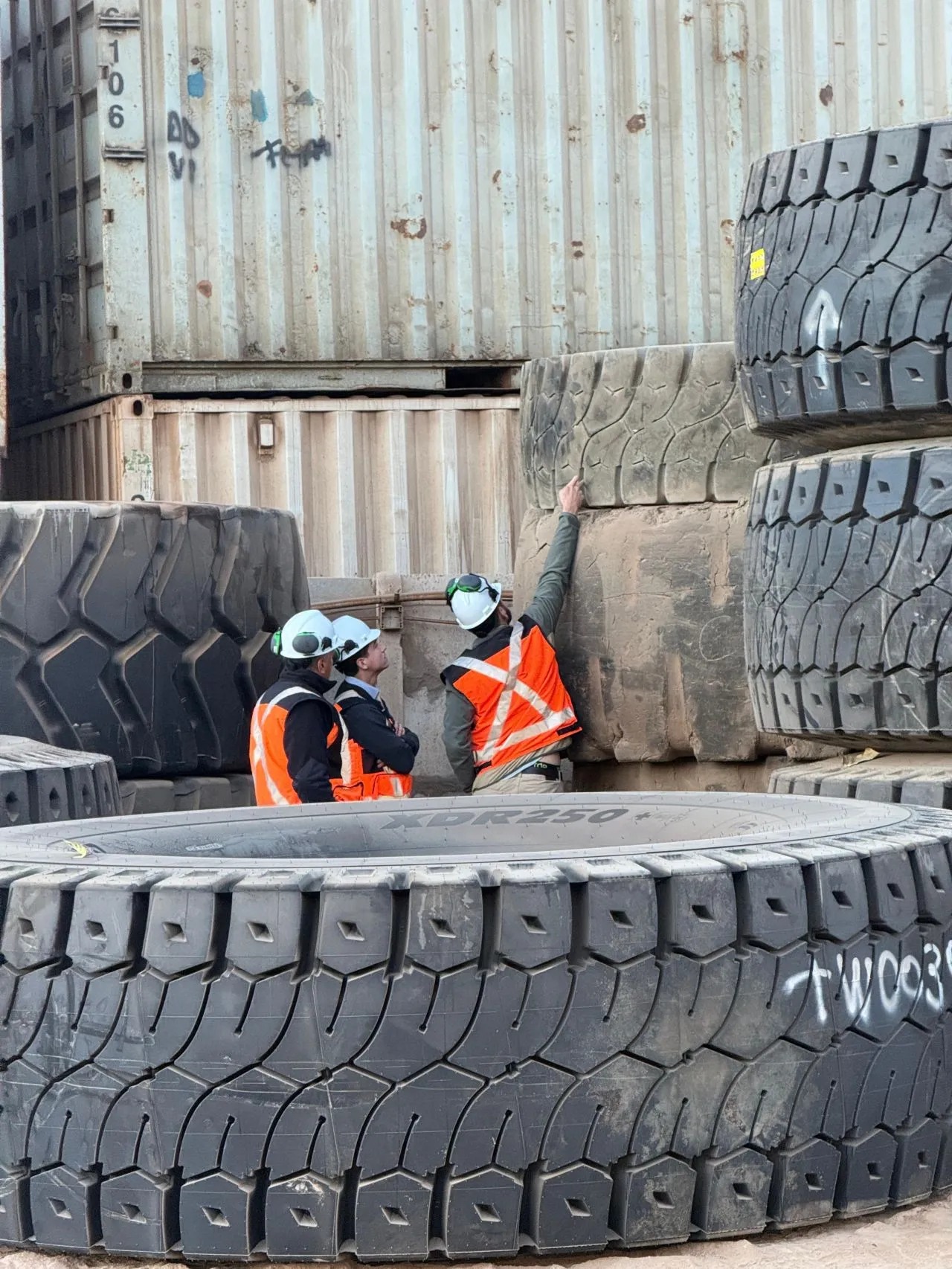
Phase 1 closed: technical feasibility, system architecture, sensing technology selection and validation plan. In progress: experimental bench validation.
A ruler gives one isolated reading each time somebody walks the site. The sensor gives the whole curve. The difference between the two is the margin the operation loses today.
The sensor registers the crossing the moment it happens. The manual record holds the last measured value until somebody next walks the site, and that difference is operating time below the limit that nobody is watching.
Illustrative schematic of the measurement principle. The curve is a wear model, not field data.
A B2B platform for time management and people management. It will have artificial intelligence built in.
We build custom software for companies only. Further detail is shared under agreement.
We learn the operation and the problem on site. If what you need can be bought, we’ll say so.
We define requirements, constraints and architecture. We evaluate the alternatives and discard the ones that don’t hit the number.
We build a working prototype and test it against a staged validation plan, on the bench and in representative conditions.
Installation, integration and commissioning in the real operation, with the engineering support it needs.
Engineers from Pontificia Universidad Católica de Chile with experience in robotics, industrial IoT, embedded systems and artificial intelligence.
Electrical Engineer PUC, PhD candidate and industrial IoT specialist.
Computer Engineer PUC, director of Caleuche UC and RobotX USA semifinalist.
Industrial Engineer, Robotics Major PUC and robotics lecturer.
Electrical Engineer, Robotics Major PUC, with experience in AI.
Electrical Engineer, Robotics Major PUC.
Write to us and we’ll look at it. Thirty minutes with an engineer, not a salesperson.
Thank you. We reply within one business day.